Publicationschevron_rightIn the Picturechevron_rightExchanging informa…
Exchanging information while negotiating transactions
Imagine…
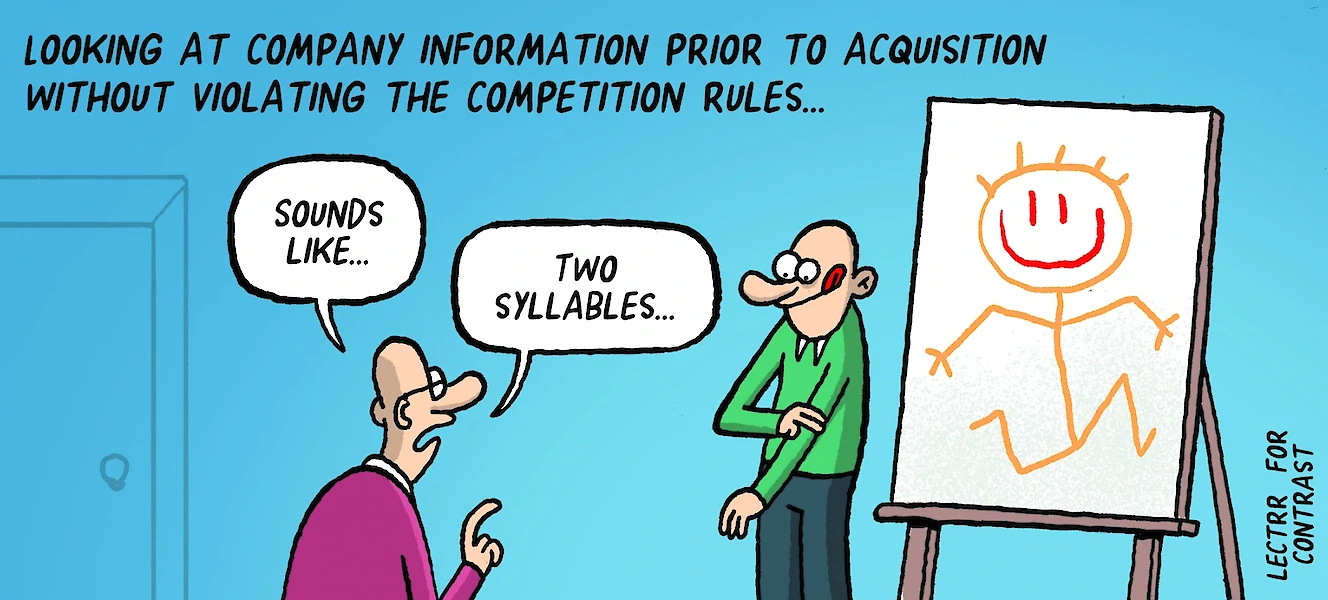
Your company's goal for the coming years is expansion. You are a member of the task force whose job is to identify potential acquisition targets, and quite a few of your competitors find themselves in that category. But to know for sure whether they are a good strategic fit, you need more information. Before asking for this information from the targets, you submit a checklist to your legal counsel. To your great surprise, he reins you in, explaining that it would be against the law to request this information. Without such information, however, it is impossible to prepare a solid acquisition file. How to resolve this dilemma?
A brief clarification.
Competition law prohibits competitors from directly or indirectly exchanging strategic data. If they do so, they reduce the market uncertainty and are thereby engaging in a secret “collusion”. Strategic data is a broad concept and can relate to prices, customer databases, production costs, quantities, turnover, sales, capacity, marketing plans, etc. The more up-to-date or future-oriented this information is, and the more individualized, the greater the risk of a restriction of competition.
Companies that are negotiating a possible takeover transaction therefore have to perform a delicate balancing act. On the one hand, they remain competitors right up to the day of closing. This means that they may not exchange any strategic data that restricts competition between them. Moreover, they must be able to continue to compete fully and normally if the negotiations fail and the transaction does not go through. On the other hand, no transaction is conceivable without an exchange of strategic information, since the buyer has to be able to form an accurate picture of the company he wants to acquire. The information is often collected in a data room to facilitate a due diligence investigation.
Concretely.
- In order to stay out of the "danger zone" of competition law, there are few rules of thumb that apply while negotiating transactions. These concern both the information exchanged and the persons who are given access to this information.
- First of all, do a case-by-case analysis of the sensitivity of the data that are exchanged. Only the exchange of “strategic” data is sensitive. This depends on the activities of the company, the nature of the data and how old they are. Information about future prices or quantities is always strategic. By contrast, aggregated and anonymized information (e.g. with the customer names removed) is not strategic, nor is historical information (generally: any information that is more than one year old). And publicly available information that is accessible for everyone is not strategic either.
- It is necessary to build in certain guarantees for the exchange of strategic information. These guarantees ensure that the exchange is limited to what is actually necessary for the success of the negotiations. Furthermore, they must ensure that the companies involved can continue to compete properly if the transaction does not come to fruition.
- Sign a confidentiality agreement in which the guarantees are explicitly established.
- Anonymize and aggregate the strategic information as much as possible.
- The information may only relate to the target. Normally there is absolutely no reason for the buyer to communicate any sensitive information to the target.
- Put together a “clean team”. That way, you ensure that only the necessary persons in the company get to see the information. The clean team can be composed of senior employees who are directly involved in the project or external third parties. Make sure that people who deal with day-to-day operations and pricing do not form part of the clean team. Strategic information may not be shared outside of the clean team.
- Exchange solely that information which is necessary for the purposes of the transaction (“need-to-know basis”). The communication of future pricing, for example, is something that cannot be done.
- Make clear agreements on what is to happen with the information if the transaction does not go through (return, destroy).
Want to know more?
- Consult the Guidelines on the applicability of article 101 of the Treaty on the Functioning of the European Union on horizontal cooperation agreements here.
- Consult the documentation from the “Due Diligence in practice” seminar offered by contrast law seminars.
Other In the Picture
View all publications


Sign up for our newsletter
Don’t miss out on new publications and legal updates from contrast. Sign up to receive our latest news straight to your inbox.