Publicationschevron_rightIn the Picturechevron_rightSold, but not off …
Sold, but not off the hook: what our latest M&A Survey reveals about seller liability in Belgian M&A transactions
Imagine...
You own a company that you have carefully built up for decades. After years of hard work, long hours and entrepreneurial risk, a buyer is interested in taking over your company. The purchase price has been agreed and you can already picture yourself leaving behind the stress of running a business.
Then your lawyer sends you the draft share purchase agreement. The buyer expects you to give a broad set of representations and warranties about the company. Your lawyer explains that if one of those statements later proves incorrect, you may still be liable after the sale.
You pause for a moment. Wasn’t the whole point of selling the company to leave the risk behind?
A brief clarification.
A share purchase agreement does more than transfer ownership of a company. It also determines which risks remain with the seller and which are passed on to the buyer.
Representations and warranties are central to that exercise. Through these statements, the seller confirms certain information about the company and its operations. If a statement proves inaccurate, the buyer may have a claim against the seller. A seller should therefore not expect to walk away entirely free of risk.
The good news is that there are established market standards in Belgian M&A practice which make that risk more predictable and manageable. The sixth edition of contrast’s M&A Survey provides an overview of these market practices and shows how they have evolved over more than two decades.
First, proper disclosure can significantly reduce the seller’s exposure. Information disclosed to the buyer can “qualify” the representations and warranties. This means that the buyer cannot bring a warranty claim based on a matter which was disclosed by the seller. Disclosures can be made in several ways, including by making relevant documents available to the buyer in a data room or through a separate disclosure letter or schedule.
Data room disclosures have become particularly important: 91% of the reported transactions treated information in the data room as disclosed against the representations and warranties.
Second, the seller’s liability is usually limited in time and amount. The share purchase agreement typically limits the period within which the buyer can bring a warranty claim and sets financial limits on the seller’s liability.
In this context, a general limitation period of 24 months is the prevailing market standard, but it is also customary to agree on exceptions to that general limitation period.
The agreement will also typically exclude claims below agreed minimum thresholds, preventing minor claims from triggering liability. More than 9 out of 10 reported transactions included both a threshold for individual claims and an aggregate threshold for all claims taken together.
A “cap” on the seller’s total liability is also included in nearly all transactions. The median cap is 25% of the purchase price.
Third, known risks are increasingly dealt with separately. If the due diligence reveals a specific risk, such as a tax, employment, litigation, environmental or regulatory issue, the buyer may request a specific indemnity. This means that the seller agrees to compensate the buyer if that particular risk results in a loss. The M&A Survey shows a clear trend towards including such indemnities in share purchase agreements: they appeared in 78% of the reported transactions. These specific indemnities are generally subject to their own liability regime and are therefore not subject to the limitations applicable to warranty claims.
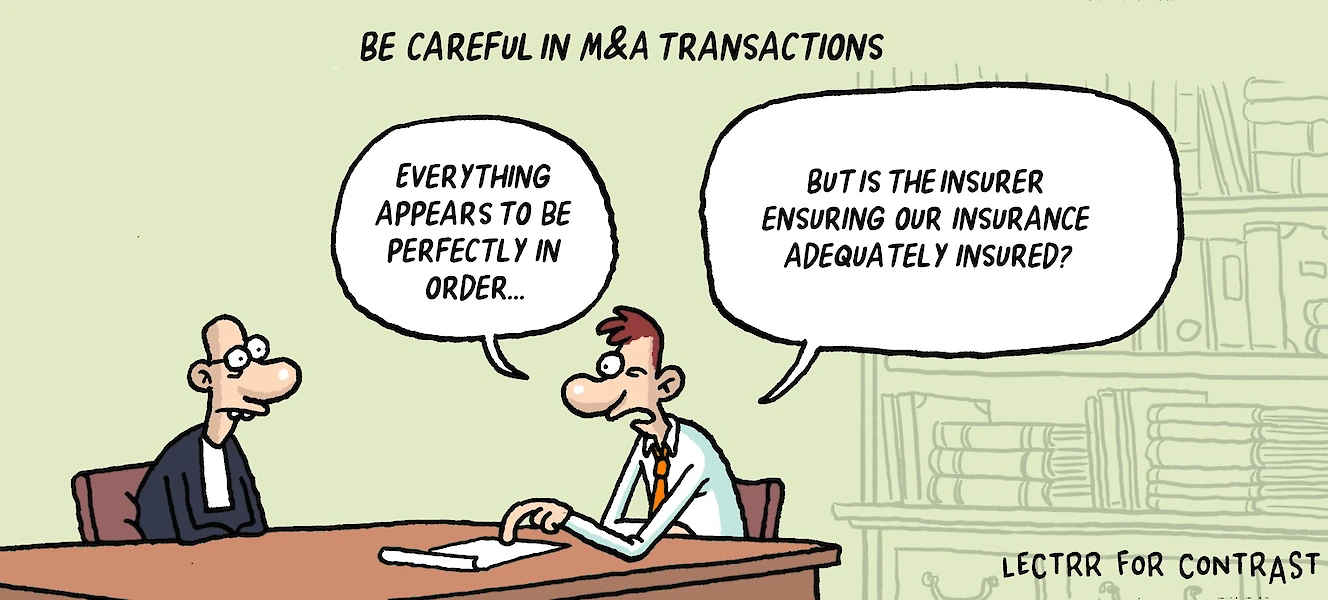
Finally, warranty and indemnity insurance can offer sellers a “clean exit”. Warranty and indemnity insurance transfers part of the risk associated with warranty claims to an insurer, thereby reducing the seller’s exposure after closing. Such insurance was used in 16% of all reported transactions and in up to 78% of deals with a transaction value of at least EUR 250 million. Accordingly, it has become standard market practice in the largest deals.
Concretely.
The sixth edition of the M&A Survey suggests that the seller of a company should:
- expect representations and warranties to remain a central part of the share purchase agreement;
- invest sufficient time in a complete and well-organised disclosure process;
- negotiate clear time limitations, thresholds and caps for warranty claims;
- carefully check which matters fall outside the general liability limitations;
- expect that known risks are addressed through specific indemnities; and
- consider whether warranty and indemnity insurance could support a “clean exit”.
Want to know more?
- The sixth edition of the M&A Survey is based on more than 500 unique transactions with a combined deal value exceeding EUR 28 billion and covers transactions concluded from 2020 through the first half of 2025. It was realised with the support of numerous investment companies, financial service providers and law firms, with the active support of Private Capital Belgium. Together with the previous editions, the M&A Survey now covers more than 20 years of Belgian M&A practice.
- Discover the full results of the sixth M&A Survey and order the printed M&A Survey booklet, the digital M&A Survey (app and web version) or a combined package via our website.


Other In the Picture
View all publications

Sign up for our newsletter
Don’t miss out on new publications and legal updates from contrast. Sign up to receive our latest news straight to your inbox.