Publicationschevron_rightIn the Picturechevron_rightCommission publish…
Commission publishes new guidelines on exclusionary practices: more clarity, but not always more certainty
Imagine...
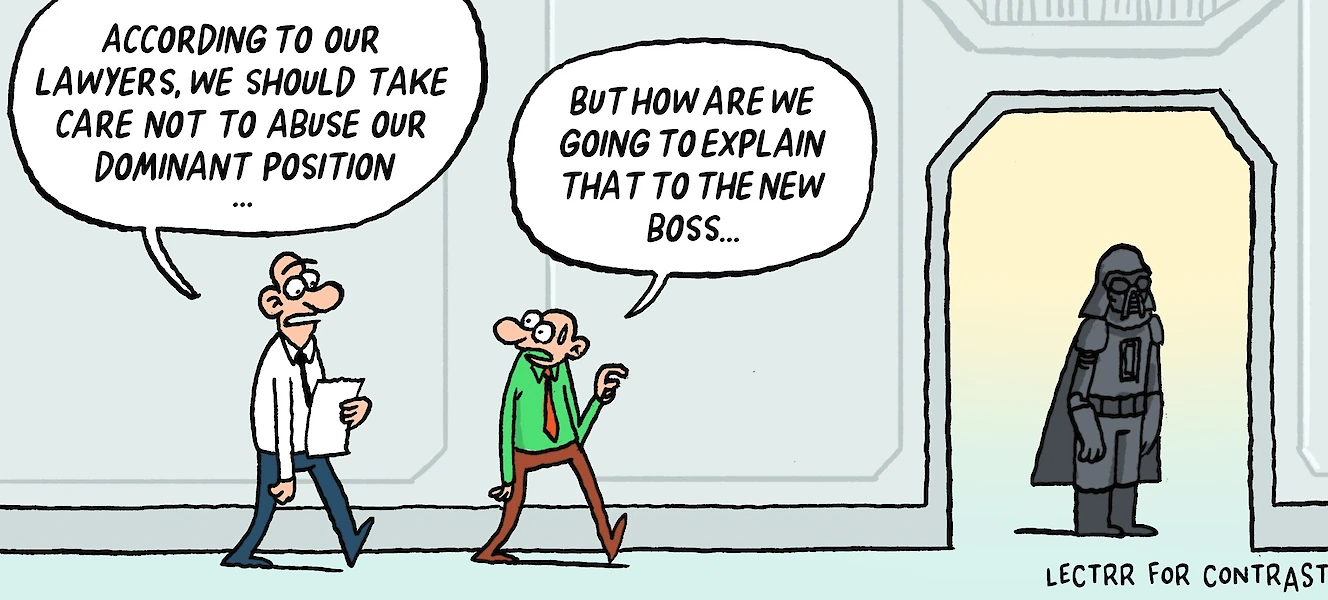
Two years ago, in our September 2024 In the Picture, we explained that a company can be dominant without doing anything wrong. Dominance becomes a problem only when the company uses its market power to exclude competitors rather than winning customers on the merits. In short: the force may be with you, but you may not exclude.
You continue to be a successful business. You are still way ahead of your competitors, but the gap is closing. To keep customers on board, you want to revisit your commercial strategy and offer better conditions. One option is to grant rebates based on the volume customers buy, without necessarily asking them to buy exclusively from you. After all, this is what customers want and what competitors are already doing.
For the sake of completeness, you ask Legal to confirm. They reply that it is not that simple. If a company is dominant, like yours, competition law indeed asks a second question, namely if the rebate could make it harder for equally efficient competitors to remain on the market. That is why the legal answer depends not only on the commercial intention, but also on the design of the rebate, the market context and its possible effects.
Legal refers to fresh guidelines by the European Commission to help dominant companies assess whether their conduct risks constituting an abuse of a dominant position because it aims at or may lead to excluding remaining competitors from the market.
A brief clarification.
A company that holds a dominant position has a special responsibility. It may compete hard, lower prices, improve products and win customers. What it may not do is use its market power in a way that prevents equally efficient competitors from competing effectively.
On 3 September 2026, the European Commission adopted its final Guidelines on exclusionary abuses. The Guidelines bring together the main case law of the EU courts on these types of abuse and explain how the Commission intends to apply the principles in future cases. They will therefore be an important reference point, both for the Commission and for national competition authorities.
The Guidelines first explain how to assess whether a company is dominant and contain a useful section on dominance in after-markets. They then discuss several types of conduct that may amount to an exclusionary abuse, including predatory pricing, margin squeeze, rebates, exclusive dealing, tying and bundling, restrictions on access, refusal to supply, self-preferencing and certain practices that the Commission considers harmful by their very nature. The list is not exhaustive, so other practices may also be abusive if they are capable of excluding competitors.
For volume rebates, the Commission identifies several factors that may be relevant. If the rebates are monetary, the key question will often be whether they make the effective price fall below cost. In simple terms, this means asking whether an equally efficient competitor could match the offer and still operate profitably. Other relevant factors may include the market coverage of the rebates, the type of rebates, whether they are tailored to individual customers, the length of the reference period and whether there is evidence of a plan to foreclose competitors.
The theory is useful. The practical assessment is often harder.
- First, there may be difficult discussions about which costs are relevant for the product concerned. It may also be hard to decide how broader costs, such as research and development costs, should be allocated across a product’s life cycle.
- Second, calculating the effective price may be complex. For example, for conditional rebates that apply retroactively to all sales (retroactive rebates), and not just to the sales above the conditional threshold (incremental rebates), the full rebate must be allocated to the price paid for the part of demand that competitors can realistically contest. That requires an assessment of what portion of the customer’s demand was genuinely open to competition. That information may be difficult for the dominant company to obtain. In the Intel-case, for example, the Commission and later the General Court assessed the contestable share on the basis of a detailed analysis that included customers’ internal documents. A supplier will usually not have access to that type of information when designing its own rebate scheme.
- The assessment may become even less predictable for practices that do not concern pricing conduct.
The Guidelines therefore provide a welcome overview of the factors relevant to assessing potential exclusionary abuse, but they do not eliminate the need for judgment. Even after the economic analysis, the outcome may remain uncertain. A competition authority may, for example, assess the contestable share of demand differently or take another view of the relevant costs. As the case law will continue to evolve, the Guidelines must also be read alongside the EU courts’ latest judgments.
Concretely.
- The Commission has published Guidelines on exclusionary practices under Article 102 TFEU. They help companies assess when market power may amount to dominance and when commercial conduct may risk being treated as abusive.
- The main message is simple. The Guidelines are helpful because they bring together the main principles developed by the EU courts. They are less helpful if one expects a checklist that will always produce a clear yes-or-no answer.
- So, the Guidelines are a useful starting point, but they do not eliminate uncertainty. In many cases, companies will still need to make a risk assessment. That may mean choosing between a safer but commercially less attractive option and a more competitive option that carries greater legal risk.
- The Guidelines deal only with exclusionary abuses. Conduct that falls outside that category may still raise competition law concerns if it is considered exploitative, for example because it unfairly harms customers rather than competitors.
Want to know more?
- The Commission’s Guidelines on exclusionary abuses of dominance can be found here.
- The Commission’s questions and answers on the Guidelines can be found here.
- The Commission’s factsheet on the Guidelines can be found here.
-
Interested in this topic? Join us for our online lunch bite on 15 October 2026. From 12:30 to 13:30 CEST, our experts will discuss the new Guidelines on exclusionary abuses of dominance and share practical insights. Participation is free of charge, and one IBJ/IJE point will be requested. Interested? Register here.


Other In the Picture
View all publications


Sign up for our newsletter
Don’t miss out on new publications and legal updates from contrast. Sign up to receive our latest news straight to your inbox.