In the Picture

Pdf version Archive Subscribe

Legal uncertainty for mergers and acquisitions between sector peers

December 2025

Imagine...

You are the CFO of a company that supplies artisanal bakeries. You acquire your largest competitor. The acquisition remains well below all notification thresholds and therefore does not need to be notified to any competition authority. You proudly announce the takeover. The business is very enthusiastic. Since there is no need to wait for approval from competition authorities, this time you won’t spoil your company's ambitious timeline. 

Or at least that’s what you thought. One day a letter from the French Competition Authority lands on your desk. It informs you that it is investigating the acquisition for a possible breach of competition law.

How strange. You had heard that this could happen when companies with a dominant position make acquisitions, but your company is not dominant at all. The letter from the French Competition Authority does not say that either, but it does say that the acquisition may be an anti-competitive agreement between undertakings.

What do you mean? Does this mean that all your acquisitions are now threatened? 

A brief clarification.

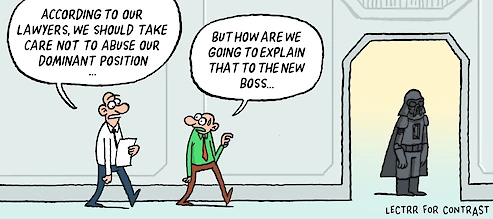
In 2023, the European Court of Justice handed down its judgment in the Towercast case. In this judgment, the Court stated that it cannot be ruled out that an acquisition that does not have to be notified in advance may nevertheless constitute an abuse of a dominant position.

This created additional concerns for dominant companies pursuing acquisitions. It should be noted however that the Court stated that it is not sufficient for a dominant undertaking to strengthen its position in order for the acquisition to be considered an abuse. Abuse only occurs if a rather complex test is met, namely if, after the takeover, "the degree of dominance thus reached would substantially impede competition, that is to say, that only undertakings whose behaviour depends on the dominant undertaking would remain in the market."

We previously noted that the Towercast judgment would not be without consequences. It now appears that those consequences are even greater than expected.

Several competition authorities, including the Belgian and French ones, have since taken the position that the Towercast judgment also means that they can investigate acquisitions by non-dominant undertakings under the prohibition of anti-competitive agreements. The test that the authorities seem to be applying is whether the acquisition leads to an appreciable restriction of effective competition. The context of the acquisition in the buyer's broader strategy is also considered.

In this way, these competition authorities are appropriating so-called 'call-in powers'. These reduce deal certainty for non-notifiable acquisitions and mergers between sector peers. In auctions, potential buyers from outside the sector now always have an advantage thanks to competition law, even if no notification is required.   

Concretely.

  • Always check whether your acquisition must be notified in advance to the European Commission or one or more national competition authorities.
  • Even if this is not the case and you are dominant, check with your legal advisors whether there could still be an abuse of a dominant position.
  • If you are not dominant, but you are acquiring a competitor or wish to merge with one, check with your legal advisors whether the transaction could lead to a significant impediment to effective competition.
  • If this is a possibility, consider notifying your acquisition to the relevant national competition authorities. If this does not appear to be a sensible strategy in the circumstances, at least be prepared for questions. In any case, consider the impact of a possible investigation in your transaction documents.

Want to know more?

Please consult our website or contact one of our team members if you have questions or require more information:

Close